SHIPPING GUIDE
Joyagoo Volumetric Weight Calculator
Calculate volume-based weight from packed dimensions, compare actual weight and understand route-specific billing rules.
On this page
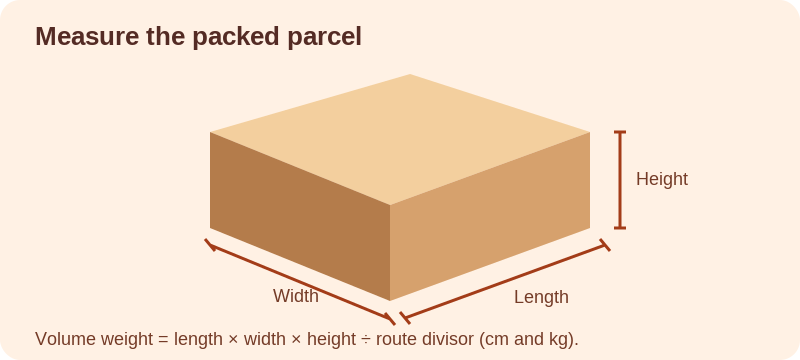
Measure the outside of the packed parcel
Volumetric weight expresses the space occupied by a package as a weight-equivalent figure. Use the outside length, width and height in centimetres, not the dimensions of a folded shirt or an unpacked shoe. Divide their product by the applicable route divisor. The official Joyagoo explanation lists several possible divisors, including 5,000, 6,000, 7,000 and 8,000; the actual service determines which applies.
Worked sensitivity comparison
| Packed dimensions | Volume cm³ | At 5,000 | At 6,000 |
|---|---|---|---|
| 40 × 30 × 25 | 30,000 | 6.00 kg | 5.00 kg |
| 40 × 30 × 20 | 24,000 | 4.80 kg | 4.00 kg |
| 45 × 35 × 25 | 39,375 | 7.875 kg | 6.5625 kg |
For an illustrative actual weight of 4.5 kg, a line taking the larger weight would use 5 kg before rounding for the first package at a divisor of 6,000. The second package would use 4.5 kg. The physical reduction is meaningful only if it changes the applicable billing bracket or other charge.
Check the route rule before interpreting the result
Not every route uses the same weight calculation. The local calculator reports the computed volumetric weight and the larger of the entered actual and volumetric figures; it cannot determine the final charge for a service. Consult the official route weighing standards, then account for any increments, minimums and exceptions.
Balance packing against protection
A smaller box may reduce occupied space, but fragile goods or shaped footwear may need protection. Compare a packed configuration that still protects the contents. Ask for current measured dimensions through the appropriate warehouse service instead of assuming that removing a box always reduces the invoice.
A packing sensitivity comparison
An illustrative box of 40 × 30 × 25 cm has volume 30,000 cm³. Reducing only height to 20 cm yields 24,000 cm³. At a divisor of 6,000, volumetric mass changes from 5 kg to 4 kg. For an actual mass of 4.5 kg, the larger-of-two rule would produce 5 kg versus 4.5 kg before line-specific rounding. The change is not automatically a freight saving: check the actual rule, rounding and protective needs, then obtain comparable quotes.
References
mgt.joyagoo.com — Actual weight and volumetric weight ↗
mgt.joyagoo.com — Weighing standards for each transportation services ↗
Frequently asked questions
What is the formula?
Length × width × height in cm divided by the applicable divisor gives volumetric kilograms.
Is the larger calculated weight always the billed amount?
No. It depends on the route and any rounding or exceptions.
Can I use item dimensions instead of parcel dimensions?
Only as a preliminary estimate; use packed external dimensions for a closer comparison.